
Small Wind Turbines
What is a wind turbine?
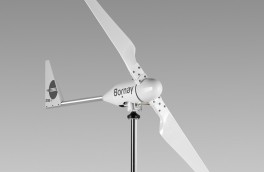
A wind turbine is an electromechanical system that converts the kinetic energy of the wind into electrical energy. Its blades capture the wind and, through their rotation, transmit the movement to a generator that produces electricity.
Wind energy is one of the oldest, most mature and cleanest renewable energy sources available today. It is widely used both in large wind farms and in small and medium-power installations, which is the core focus of Bornay’s technology.
How does a wind turbine work?
The basic operating principle of a wind turbine consists of the following stages:
1. Wind orientation
The turbine blades automatically align themselves to capture the wind in the most efficient way.
2. Rotor rotation
The wind causes the blades and rotor to spin, transmitting rotational movement to the alternator shaft.
3. Power generation
The alternator converts mechanical rotational energy into electrical energy.
4. Energy management
The control system conditions the generated electricity for direct consumption, battery storage, or grid connection, depending on the type of installation.
Benefits of wind turbines
✔ Renewable energy 24/7
Wind turbines generate electricity day and night, whenever sufficient wind is available. This makes them an ideal complement to other renewable sources, such as solar photovoltaic energy, ensuring greater continuity of power supply.
✔ Clean and sustainable energy
As a renewable energy source, wind turbines contribute to clean and sustainable power generation, using an inexhaustible natural resource — the wind — while significantly reducing CO₂ emissions.
✔ Versatile applications
Wind turbines can be used in a wide range of applications, including off-grid homes, farms, agricultural and rural installations, commercial facilities and energy communities.
Types of wind turbines
- Horizontal-axis wind turbines
The most widely used type, offering higher efficiency for low and medium-power applications, suitable for both residential and industrial use.
- Vertical-axis wind turbines
Less common. Their design makes them easier to install in confined or urban spaces, as they are less affected by turbulent wind conditions.
Bornay manufactures exclusively horizontal-axis wind turbines, focusing on maximum efficiency, reliability and long-term performance.
Wind turbines vs solar technology
Wind turbines provide a more stable energy production, generating electricity both during the day and at night. For this reason, they are the perfect complement to photovoltaic systems, especially in off-grid or hybrid installations.
Combining wind and solar energy allows:
- Increased energy autonomy
- Reduced battery charge and discharge cycles
- Improved overall system performance
Typical applications
- Off-grid installations
- Residential and rural self-consumption
- Rural electrification projects
- Energy communities
- Grid-connected systems
- Support for solar photovoltaic installations
- Telecommunications systems
- Water pumping systems
This wide range of applications makes small wind energy an effective solution for covering low and medium power requirements, as well as for developing advanced hybrid energy systems.
Why choose Bornay wind turbines?
Bornay wind turbines stand out for their reliability, durability and high performance, backed by over 50 years of experience in small wind energy and more than 12,000 installations worldwide.
They are designed to integrate efficiently into residential, rural and off-grid environments, offering:
- Low maintenance requirements
- High-quality materials
- A design focused on long-term durability and optimal performance
Explore our range of Bornay wind turbines and find the ideal solution for your energy needs.
Since 1970 providing solutions to the world of renewable energies.

1970 First Bornay
Juan’s continued research brings key improvements to the Bornay. Both the body and the yaw stabilizer of these windturbines are made
of fiberglass. And right from the first moment, the Bornay has an orientation system using slip rings and brushes, enabling risk-free energy
transmission for the windturbine. With these improvements, the company can go global. Obtaining clean energy by harnessing the power
of the wind is breaking through just as the planet is shaking off the hangover of the recent great oil crisis.

1978 Fiberglass parts
Juan’s continued research brings key improvements to the Bornay. Both the body and the yaw stabilizer of these windturbines are made
of fiberglass. And right from the first moment, the Bornay has an orientation system using slip rings and brushes, enabling risk-free energy
transmission for the windturbine. With these improvements, the company can go global. Obtaining clean energy by harnessing the power
of the wind is breaking through just as the planet is shaking off the hangover of the recent great oil crisis.

1982 Induction alternator
Serial production begins with the G200W model equipped with an induction alternator, which improves the startup point at low wind speeds. Bornay reaches new markets: the United States, Mexico, the Dominican Republic and Argentina, among others. At the same time, in Africa, Bornay’s wind turbines and windpumps calm the thirst of large areas of Angola and Tanzania.

1984 Injection nylon blades
Bornay evolves. From manually handcrafting blades, the company starts producing injected nylon blades able to withstand
hurricane force without breaking. This innovation cuts production time and increases the durability of the Bornay. Its pioneering
essence is enhanced by intense production and sales activity. America, Europe, and Africa now count on Bornay reliability.

1988 Permanent magnet alternator. Adjustable blade Pitch.
The company has consolidated and matured. Innovation and the urge to supply places in need of energy inspires Bornay to new heights as the company creates a new windturbine equipped with a 250W three-phase permanent magnet alternator complete with adjustable blade pitch. This boosts the features of the Bornay, especially in low and medium wind speeds. The introduction of an automatic brake system and mechanical blade pitch control means the attack angle of blades can be adjusted relative to the wind, bringing startup with low wind conditions and control at high speeds - a constant challenge for Bornay. In fact, in a few short years this innovation will be improved upon with the production of a windturbine incorporating an adjustable three-bladed rotor and 500W nominal power.

1993 Fiberglass/carbon fiber blades. Tilting brake.
Bornay heeds market requirements and comes up with a smart answer, creating a new range of windturbines: Inclin range, with power options of 250W, 600W, 1000W and 2500W, robust machinery replacing the adjustable blade pitch with a tilting brake system, and using fiberglass/carbon fiber blades in place of injected nylon.
Now the world starts admiring Bornay’s greater sturdiness, durability, and reduced maintenance needs.

1993 Neodymium magnets
The company has consolidated and matured. Innovation and the urge to supply places in need of energy inspires Bornay to new heights as the company creates a new windturbine equipped with a 250W three-phase permanent magnet alternator complete with adjustable blade pitch. This boosts the features of the Bornay, especially in low and medium wind speeds. The introduction of an automatic brake system and mechanical blade pitch control means the attack angle of blades can be adjusted relative to the wind, bringing startup with low wind conditions and control at high speeds - a constant challenge for Bornay. In fact, in a few short years this innovation will be improved upon with the production of a windturbine incorporating an adjustable three-bladed rotor and 500W nominal power.
2000 Fiberglass/carbon fiber blades by RTM.
Three decades after Juan Bornay’s earliest prototypes and his wind simulation experiments, Bornay is now a prestigious name brand in the nascent renewable energy industry. Through constant innovation and productivity improvements, the firm has also secured a solid international distribution network. With serial production of 5 models ranging up to 6KW, Bornay takes a new step forward, developing a new RTM-based production system of fiberglass/carbon fiber blades, achieving a weight/resistance ratio that is unique in the marketplace. Bornay outlines its current strategic plan: Bring the world clean energy solutions as one of the key worldwide manufacturers in small-scale windturbine production.

2008 Grid connection systems
There is now no turning away from the need to make efficient, clean energy production systems available. Bornay sees this challenge as an opportunity and is creating specific windturbines for connection to power grids that comply with each country’s national norms regulating the flow from small wind power.
This transformation means Bornay is now moving towards the synergy of adding in energy from other renewable sources such as photovoltaics.

2017 Wind +, a step ahead in small wind turbines
This planet will not now conceive of any form of development which does not respect the environment. Resources are dwindling.
But energy demands are greater than ever. What started as a dream is now a priority. Harnessing wind power and manufacturing reliable windturbines is a guarantee of commitment to the sustainability of the planet.
Against this backdrop, Bornay has a presence in 50 countries as a reputable firm backed by its history and the sturdiness of its machinery.
And it wants to bring the world renewable energy solutions and invite industry’s best professionals to carry on evolving and join the Bornay experience.