
Sistema híbrido eólico y solar para telecomunicaciones
Los sistemas híbridos de energía eólica y solar garantizan un suministro eléctrico continuo y fiable para instalaciones de telecomunicaciones ubicadas en zonas sin acceso a la red eléctrica. La combinación de ambas fuentes renovables, junto con un sistema de almacenamiento, permite alimentar de forma autónoma estaciones base, repetidores, enlaces de radio y otros equipos críticos durante todo el año.
What is a Hybrid Wind and Solar System for Telecommunications?
A hybrid wind and solar system for telecommunications is an installation designed to autonomously supply electrical power to telecommunications equipment located in remote or difficult-to-access locations.
The system combines a wind turbine and photovoltaic solar panels to generate electricity from two complementary renewable energy sources. The energy produced is managed by charge controllers and stored in a battery bank, ensuring the continuous operation of the equipment even when there is no instantaneous energy production.
The stored electricity directly powers telecommunications equipment such as mobile base stations, radio repeaters, wireless links, surveillance systems, weather stations or any other critical infrastructure requiring a continuous power supply.
Thanks to the complementary nature of wind and solar resources, this type of installation provides high energy availability, reducing the need for generator sets and minimizing operation and maintenance costs at remote sites.
Why Combine Wind and Solar Energy in Telecommunications Installations?
Telecommunications infrastructure requires a continuous power supply 24 hours a day, regardless of weather conditions. Combining wind and solar energy increases energy availability by harnessing two renewable resources with complementary generation profiles.
While photovoltaic production is concentrated during daylight hours, the wind turbine can generate electricity both day and night whenever suitable wind conditions are available. This complementarity improves continuity of supply, optimizes battery charging and reduces dependence on fossil fuel-based backup systems.
At Bornay, we design hybrid telecommunications solutions tailored to each site, sizing the wind turbine, photovoltaic array, energy storage system and electronic control equipment to ensure reliable, efficient and sustainable operation throughout the year.
Telecommunications Installation
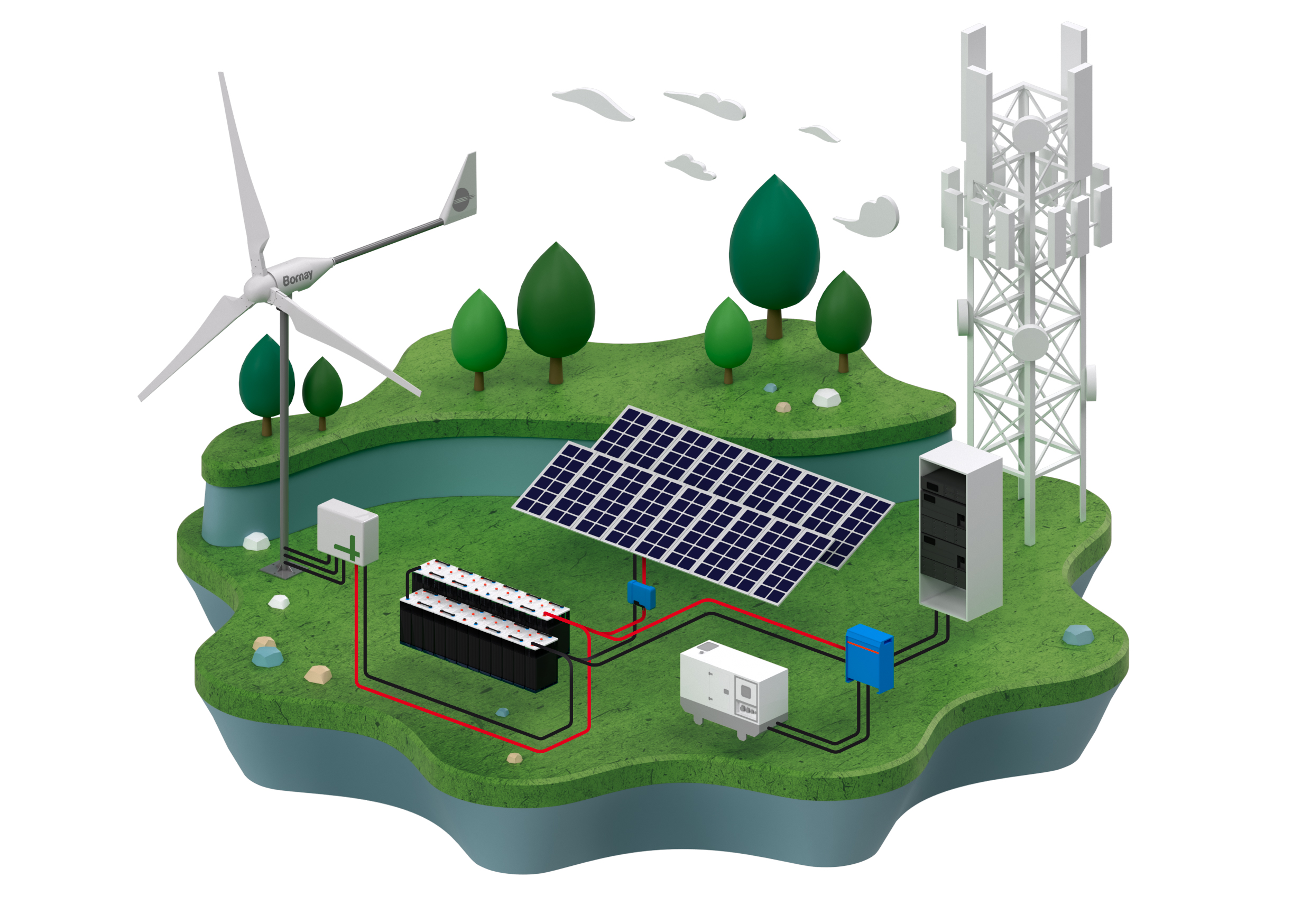
General Description
The hybrid telecommunications installation combines a wind turbine and photovoltaic solar panels to generate electricity from wind and solar radiation, ensuring a continuous energy supply at locations without access to the electrical grid.
The energy generated by both renewable sources is managed by their respective charge controllers and stored in a battery bank, ensuring that the telecommunications equipment is powered 24 hours a day.
An inverter converts the stored energy into alternating current when required by the installation, while equipment operating on direct current can be powered directly from the battery system through the corresponding control devices.
This solution provides a reliable power supply, reduces maintenance requirements and minimizes the need for generator sets at remote sites.
Wind Turbine
Generates electricity from wind energy, producing power both day and night whenever suitable wind conditions are available. Its rated power should be selected according to the energy requirements of the installation. Bornay offers 1, 3 and 5 kW wind turbines, specifically designed for integration into hybrid solar photovoltaic systems.
Wind Charge Controller
Controls and optimises the operation of the wind turbine by converting the generated alternating current (AC) into direct current (DC) for charging the battery bank. It also manages the charging process and protects the batteries against overcharging, helping to extend their service life and ensuring safe system operation.
Solar Panels
Generate electricity from solar radiation, producing energy during daylight hours. Combined with the wind turbine, they form a hybrid renewable energy system that takes advantage of two complementary energy sources, improving energy production and availability throughout the year. The number and power of the photovoltaic modules are sized according to the energy demand of the installation.
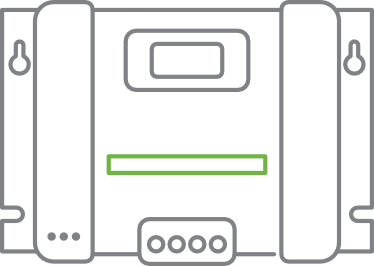
Solar Charge Controller
Manages the electricity generated by the solar panels and controls the charging process of the battery bank. It optimises system performance and protects the batteries against overcharging and deep discharge, ensuring efficient operation and extending battery life.

Batteries
Store the electricity generated by the wind turbine and solar panels, supplying power whenever renewable generation is insufficient. They form the energy storage system of the installation, ensuring a continuous electricity supply during the night, periods of low solar radiation, or when wind conditions are insufficient. Battery capacity should be sized according to the required energy consumption and autonomy.
Bornay offers both lead-acid batteries and lithium batteries for this type of application.

Inverter – Inverter/Charger
Converts the direct current (DC) stored in the batteries into 230 V alternating current (AC) suitable for powering standard household appliances and electrical equipment.
Inverter/charger models also incorporate a battery charger that allows battery charging from an external AC source, such as a generator or the utility grid when available.
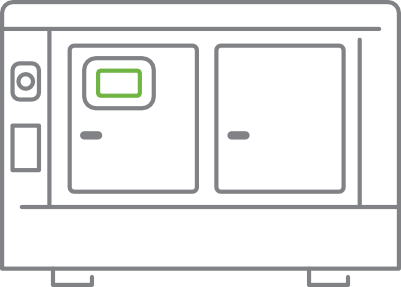
Backup Generator
Provides a backup power source when renewable energy production is insufficient to meet demand or when the battery charge level becomes too low. It typically operates on fossil fuels and can start automatically via the inverter/charger to supply the installation and recharge the batteries, ensuring uninterrupted power under all circumstances.
Other features / options:

Traditional System
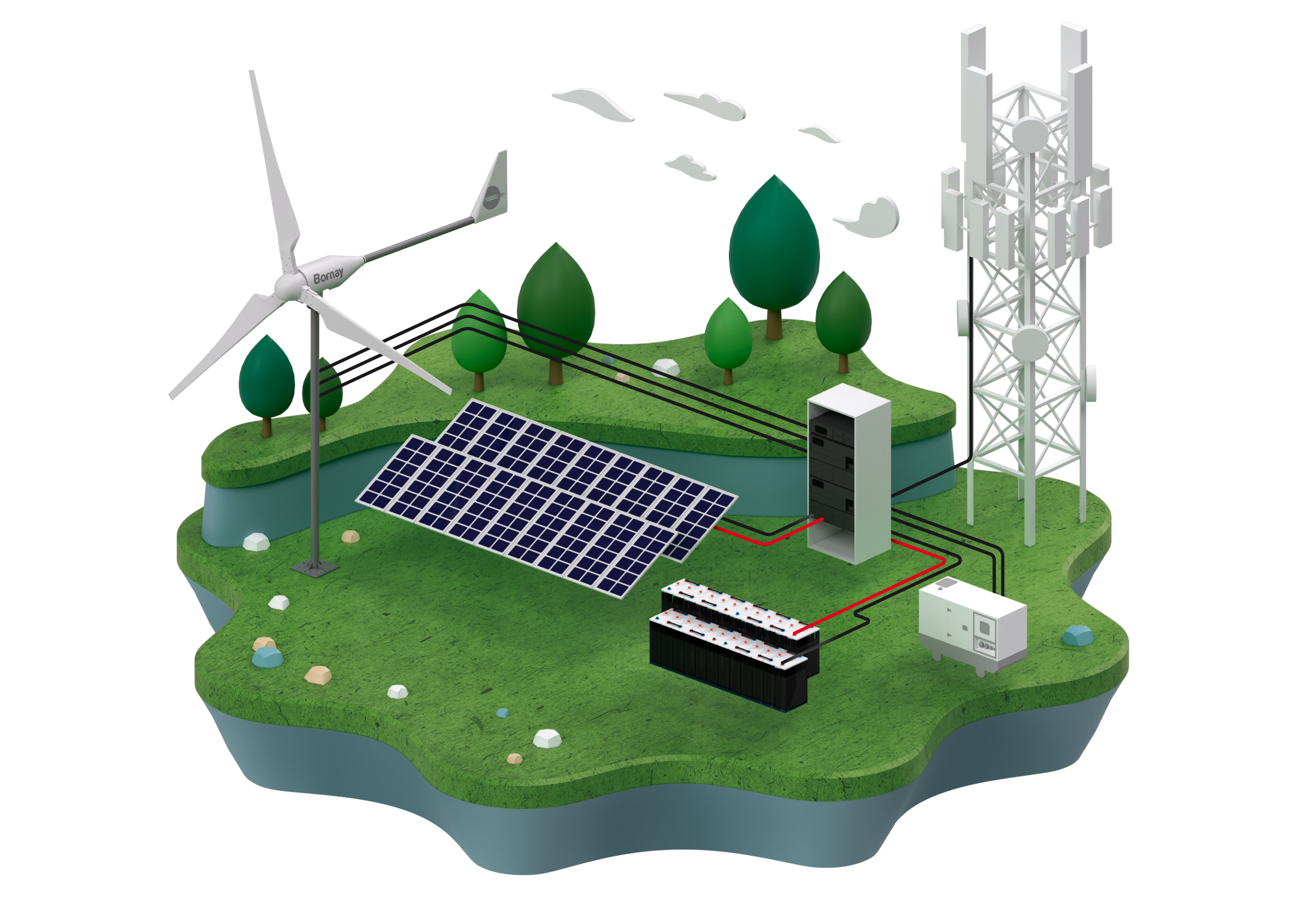
This is an off-grid installation, identical to those used for other types of applications. The wind turbine and photovoltaic solar panels, through their respective charge controllers, charge a battery bank from which power can be supplied to the telecommunications system, either directly at 48 V DC or as AC power through an inverter or inverter/charger.
This system operates independently of the telecommunications equipment, supplying power in the same way as any other energy source.
Telecom System
Some Telecom systems incorporate all the elements required for centralized energy management within their own ecosystem. These systems may include MPPT charge controllers for photovoltaic solar energy, charger/rectifier modules for battery charging, their own battery bank, as well as proprietary management and communication systems that control the entire ecosystem.
At Bornay, we have developed a rack-mounted module based on the Interface, enabling the wind turbine to be integrated directly into the manufacturer's Telecom ecosystem.
Through the Interface, the energy generated by the wind turbine can be fed into either the DC bus or the AC bus, depending on the manufacturer's system, within a predefined voltage range. Using Modbus communication, the Interface can communicate with the manufacturer's own management system, enabling wind turbine operation and battery charging to be managed, as well as allowing the wind turbine to be monitored directly from the Telecom manufacturer's management system.